
 Printer-friendly version

 Story and photo by Paul Levikow
April 22, 2026 (Alpine) -- California Secretary of State Dr. Shirley Weber recently delivered an assessment of the challenges facing the state’s electoral system, while urging vigilance and civic participation ahead of the 2026 elections.
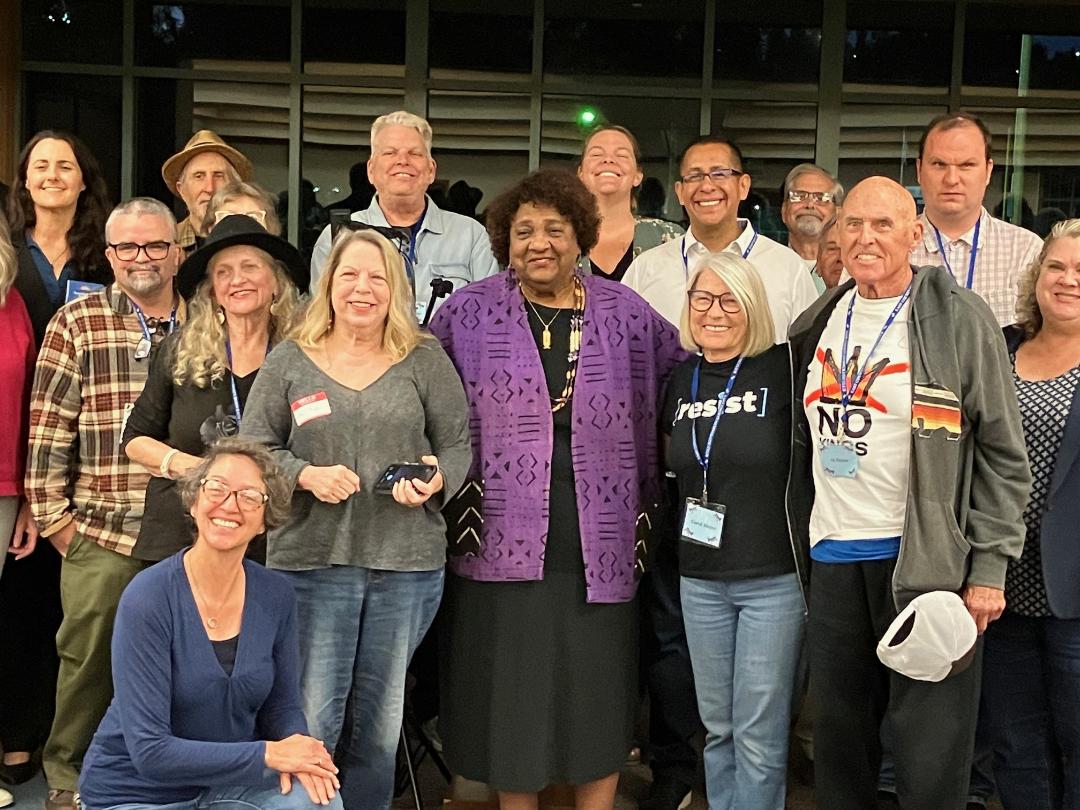
About 30 attendees gathered at The Alpine Club for the East County Democratic Club’s April meeting to hear from the state’s chief elections official. Weber’s message carried urgency shaped by both personal history and her experience overseeing elections in the nation’s most populous state.
Weber, a former teacher, university professor and San Diego School Board of Education member, recounted her initial reluctance to accept the role of Secretary of State when asked by Governor Gavin Newsom.
She was serving her fifth term as a member of the California State Assembly representing San Diego when the call came.
“I had no interest at all, except for one fact, that my parents appreciated the ability to vote. They never got a chance to do it in Arkansas,” said Weber, who moved to California as a young child. “They not only appreciated it so much, they registered to vote as soon as they got to California.”
That family history, she explained, instilled in her a deep respect for voting rights. Her mother not only worked at the polls, but eventually turned their home in South Central Los Angeles into a polling place.
“I knew there would be an opportunity to raise some issues and defend our democracy,” Weber said.
Nation in peril
That sense of mission intensified shortly after she assumed office.
“I realized that this nation is in peril,” she said. “Two weeks later, January 6th happened.”
Weber connected that moment to a broader global trend she has observed during her travels.
“In many parts of the world, people are attacking the voting system, they are attacking their democracy,” she said. “They are using fraud and deception, and people are not winning elections.”
According to Weber, similar pressures are now being directed at California’s election system.
Federal government interference
“We are now in the midst of a very unique election,” she said. “We are almost threatened or sued every day. The issue of voting is forever under attack.”
She cited ongoing clashes with federal authorities as an example.
“Last year the Department of Justice wanted all the California data,” Weber said. “They wanted all of your names, your social security numbers, where you work, they wanted everything about you.”
California refused, she said, leading to legal action.
“They sued me personally for the information and the data,” Weber said. “We went to court and we won. That has not stopped.”
Weber added that subsequent efforts by federal agencies sought similar access.
“There was an executive order that led to the Department of Homeland Security saying they wanted all of our data,” she said. “They want all of our information on all of you so they can create a database and list of all voters in California.”
She emphasized that California has resisted those efforts based on states’ constitutional authority.
States control elections
“By law, California, as well as every state in the union, has a right to define its voting system,” Weber said. “So we’re fighting back as usual to make sure that we protect you and everything that’s about you.”
She noted that some states that complied with such requests have since expressed regret.
“Some states did give up the information, and now they are sorry that they did,” she said. “We are fighting this battle constantly, and we anticipate even more.”
Misinformation
Weber also addressed what she described as a growing threat from misinformation.
“Pay attention to what you hear,” she said. “Don’t spread lies that aren’t true. Don’t share misinformation and disinformation with people to create fear in the public about what we do and how we vote.”
Even those who doubt false claims can contribute to the problem, she said. “Even those people who don’t believe it, they’ll spread the lie.”
Weber rejected allegations of widespread election fraud.
“We’re not hiding things. There is no deception, there is no fraud,” she said. “There is always some attention to basically trying to figure out how we can, quote, improve our system, but there is no data or evidence that the system is broken.”
Weber pointed to repeated court rulings backing that position.
“We’ve gone to court many times and in every situation the judge has basically said there is no deception, there is no fraud,” she said. “If there is anything, it is so minor, so small, it’s insignificant.”
Despite the challenges, Weber offered a message of optimism.
Reason to be optimistic
“It’s still a good system, our democracy is still strong, but it is only going to be as strong as you are and your determination to make sure that you fight for it every step of the way,” she said. “You cannot give up, you cannot turn your back, you cannot decide you’re not going to vote, because not voting is voting. We all get frustrated. But you don’t give up the ship because you’re frustrated. You fight back and you make sure that it happens.”
Weber told the enthusiastic audience that “we want a state that is strong, we want a nation that’s strong, we want a constitution that’s strong, we want people in the legislature who will fight for us, Democrats and Republicans. We want folks who are willing to stand with the constitution and defend it.”
Looking ahead to the 2026 elections, Weber outlined California’s voting process, which continues to emphasize accessibility. The state will again offer 11 days of in-person voting at voting centers, along with vote-by-mail options and secure ballot drop boxes.
The California Secretary of State’s Office and other state officials are preparing extensively for potential disruptions.
California is prepared
“There is an army of lawyers trained and ready to respond if anything happens on Election Day,” Weber said. “There are people working around the state with their eyes and ears open in case there are any issues, they can respond immediately.”
She acknowledged the possibility of attempts to intimidate voters.
“We know that things can happen. We hope they don’t. But we’re not asleep on it, and we will fight back in terms of going into court to stop the things that are happening with law enforcement and those kinds of things,” Weber said. “It’s clear that they’re going to try to do something. They might not be very effective in doing it. Most of it is really to make you afraid to go to the polls, to make you afraid to turn your ballot in.”
She contrasted California’s approach with proposals for more restrictive voting systems.
“Trump would like us to have one day, all in-person voting so that they can limit the number of people who show up,” Weber said. “We’ve never had a president do the kind of things we’re seeing now. Many of the things that I thought would never happen in this country are happening.”
Weber did not shy away from criticizing national political rhetoric surrounding elections. Still, she emphasized that the outcome will depend on civic engagement and adherence to democratic principles.






Recent comments